
Algorithms and machine learning
Structured non-repeating benchmark geometry for spatial algorithms and geometric ML.
A structured geometric dataset
A monotile patch can be represented as polygons plus affine transforms, or as a graph whose nodes are tiles and whose edges mean “shares a boundary.” Node features may include orientation, hierarchy label, area, centroid, or parent metatile. A graph embedding is a learned numeric vector that summarizes such a node or whole patch for prediction and comparison.
Deterministic generation supports reproducible benchmarks, but it does not prevent memorization. Models can memorize finite IDs, seeds, boundaries, or recurring motifs, and web provenance is difficult to rule out. Splits must therefore hold out entire parent supertiles, patch regions, scales, or generator configurations rather than randomly splitting neighboring tiles.[2]
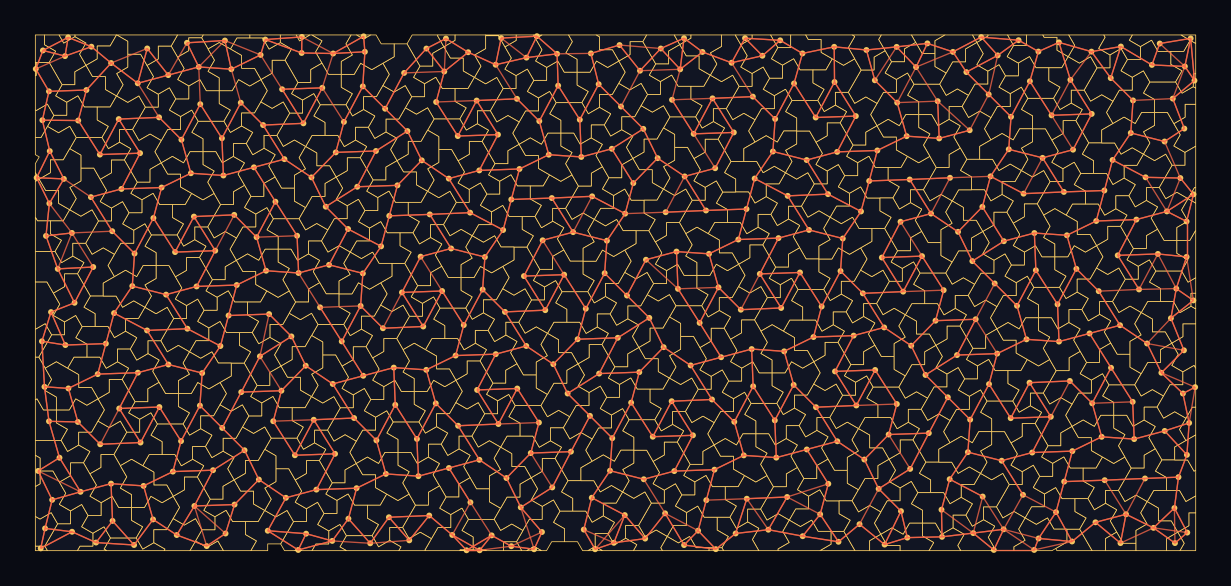
The theoretical backdrop is rich. Tiling problems sit at the edge of computability, translational tiling is undecidable for three connected polyhypercubes in four dimensions,[24] and the structured-vs-wild dichotomy is an open research program.[23] On the constructive side, SAT solvers detect isohedral polyforms,[17] exact algorithms extract rectangular repeated forms from exact symbolic grids,[25] and group-theoretic formulations connect tilings to algebra.[9] Percolation thresholds on Hat-family lattices are now being mapped by Monte Carlo simulation,[52] giving concrete statistical signatures for random-process models on monotile graphs. Batle and Bednorz extend Li-Boyle quantum error-correcting codes to Hat and Spectre tilings, grounding recoverability in the supertile hierarchy and CAP torus parametrization.[55]
Benchmark tasks and representations
- Node/edge prediction: infer missing orientation, label, adjacency, or parent cluster from a partially observed graph.
- Patch classification: distinguish canonical legal patches from overlaps, gaps, reflected errors, perturbed geometry, or other tiling families.
- Localization: retrieve a query neighborhood in a larger fixed patch under noise, occlusion, rotation, and scale change; connect to robotics.
- Generation: complete a legal frontier or predict the next substitution level, with geometric validity checked independently of pixel similarity.
- Physics surrogate: predict a published simulation target only after preserving the exact graph, boundary, and material parameters used to create labels.
Baselines, splits, and metrics
Baselines should include coordinate-only multilayer perceptrons, convolutional models on rasterized patches, message-passing graph networks, SE(2)-equivariant models, nearest-neighbor retrieval, and simple hierarchy rules. Compare with periodic grids, Penrose or other aperiodic tilings, and perturbed controls at matched node count and density.
Use region- or supertile-held-out splits with no shared descendants across train and test. Report task accuracy or F1, localization distance and angular error, graph-edit or validity rate, calibration, robustness curves, inference time, parameter count, and seed variance. Release the generator revision, split manifest, normalization, and duplicate-detection procedure.
Algorithms and computational limits
Useful non-learning methods include exact or tolerance-aware edge matching, spatial indexes over centroids, graph isomorphism tests, geometric hashing, SAT search, and substitution parsers.[17] Tiling undecidability results show that no algorithm solves every unrestricted tiling problem in the relevant settings,[24][56] but they do not make routine finite-patch tasks cryptographically hard or justify security claims.
Ref. 25 is deliberately narrow: it trims and decomposes exact rectangular symbolic matrices. On a synthetic 6×8 mixed grid it processed four of 14 composites, extracted 20 primes, and found three two-placement decompositions in 8.43 ms; worst-case growth remains exponential. It does not address perspective, curved boundaries, measurement noise, or Hat/Spectre hierarchy recovery.[25]
Percolation likewise requires a declared graph, site-versus-bond occupation, spanning rule, and finite-size scaling; a threshold belongs to that model, not to the outline alone.[52] Proposed Hat/Spectre quantum codes must report stabilizer construction, rate, distance, check weight, decoder, and threshold over growing systems; a valid finite code is not yet evidence of fault-tolerance advantage.[55] The operational distinctions and implementation contract are developed in Computational generation and navigation.
Limitations and crypto caution
Results can leak through coordinates, clipping boundaries, stable IDs, generation depth, or near-duplicate neighborhoods. A model that succeeds on one deterministic family may only have learned its generator. Test out-of-distribution scales and alternative legal patches, and distinguish exact geometry from rasterization artifacts.
Aperiodicity is not a cryptographic assumption. Do not use monotile geometry for keys, trapdoors, authentication, or obfuscation without a formal threat model, reduction or extensive cryptanalysis, and review by security specialists. Visual complexity and undecidable tiling theorems do not supply practical security.
See also
Robotics and mobility, Signal processing and imaging, Computational generation and navigation
Categories: Research frontiers