
Spectre tile
A strictly chiral aperiodic monotile, also known as Tile(1,1), discovered in 2023.
Overview
The Spectre is a 14-sided equilateral polygon, Tile(1,1) in the Hat's shape continuum, that tiles the plane aperiodically using only translations and rotations. No reflected tiles are needed, and in the strict curved-edge form, none are even possible. It was introduced in A chiral aperiodic monotile as the solution to the "vampire einstein" problem: an aperiodic monotile that casts no mirror image.[2]
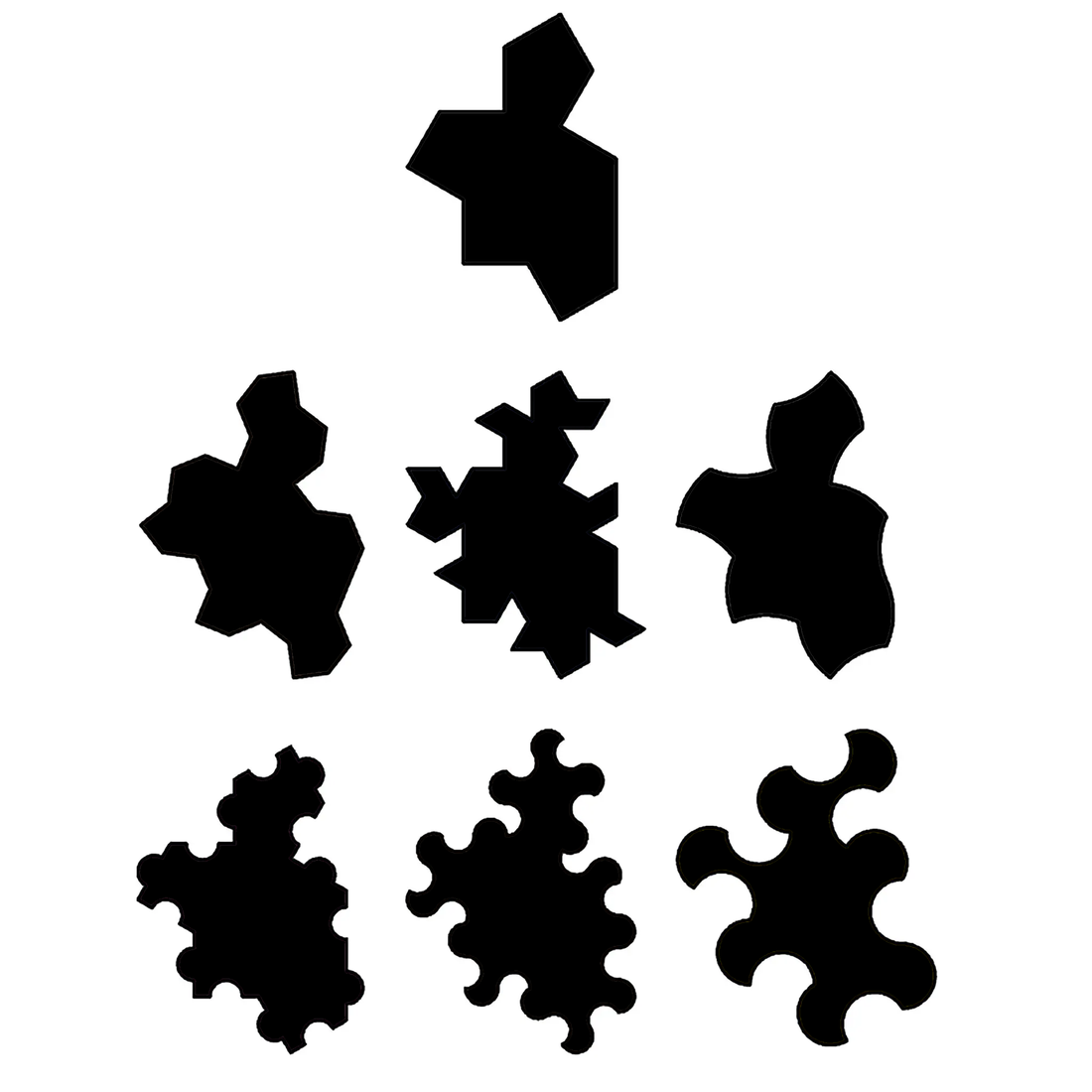
The straight-edged Tile(1,1) is subtle: allowed reflections give it a simple periodic tiling, so it is only aperiodic when reflections are forbidden by rule (weakly chiral). Modifying its edges with matching curves, any of the variant silhouettes above, removes that escape hatch and produces the strictly chiral Spectre family.[2]
Geometry and structure
Spectre tilings hide a surprising amount of internal order. Every Spectre tiling decomposes into recognizable hexagonal clusters,[11] and the whole family can be derived from an underlying rhombic tiling shared with the Hat and Turtle.[8] The substitution system that generates Spectre patches admits a homochiral (single-handed) inflation rule,[10] and tile counts per generation follow Fibonacci and Lucas number patterns.[12] Group-theoretic analysis places these tilings in a broader algebraic framework.[9] Long-range order is now understood through CASPr model sets with five Rauzy-fractal windows and pure-point diffraction,[32] and crystallographic analysis confirms non-periodic diffraction with chiral sixfold point symmetry.[34][35] Algorithmic quasilattice constructions and explicit tiling generators complement the substitution picture.[29][30]
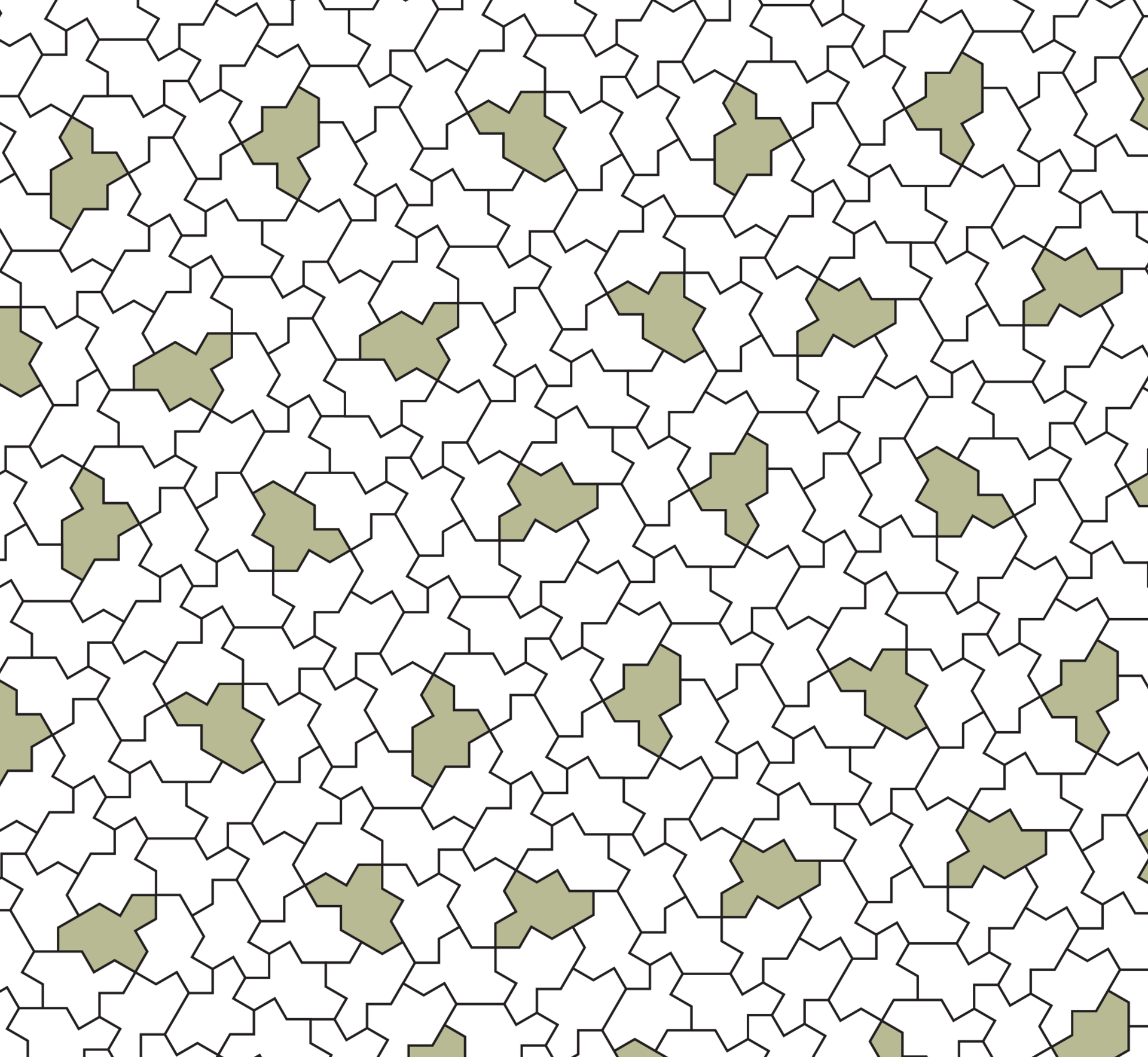
Conversions between Tile(1,1) tilings and other aperiodic families are constructive: non-periodic Tile(1,1) tilings can be transformed into tilings by other chiral monotile shapes.[16] Sugimoto’s two-part program converts Tile(1,1) patches into three-pentagon tilings,[16][57] Independent proof techniques, including Akiyama and Araki's alternative argument, confirmed aperiodicity through different routes.[4]
Substitution structure
Like other modern aperiodic tiles, Spectre patches are generated by substitution: a finite set of metatiles refines into smaller copies until a target region is filled. See Substitution tiling for the full picture, including an animated walk up the hierarchy. Public tooling, Kaplan's Spectre explorer and community ports, implements these rules for interactive exploration.[2]
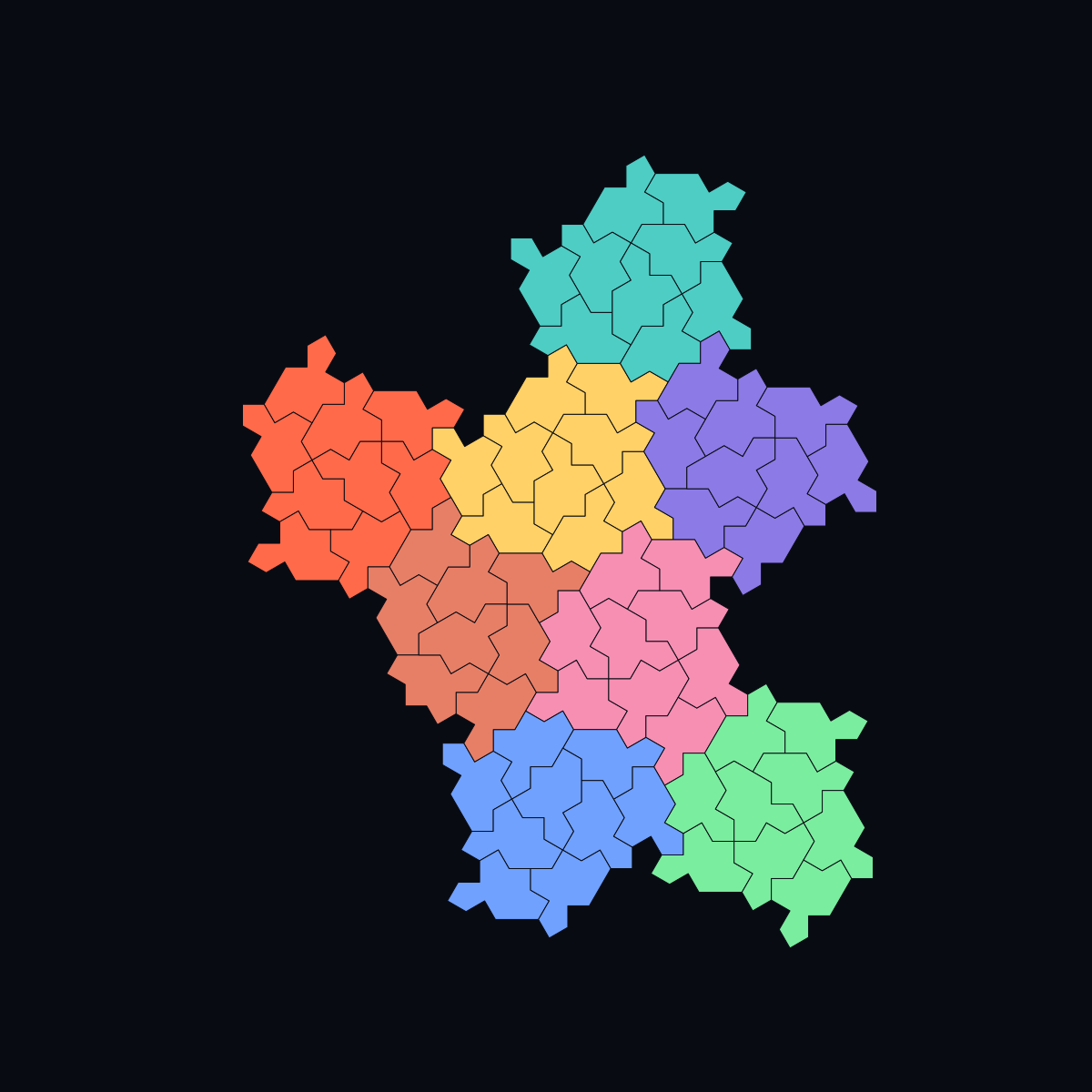
The Aperiodic Monotile API packages this mathematics for production workflows: clipped patches, stable tile IDs and transforms, and exporters (SVG, STL, GLB, CSV, JSON), the exact pipeline used to produce the renders across this wiki.
What the chiral theorem proves
The proof concerns mathematically exact tiles and allowed rigid motions. Local fits force a small family of larger clusters, and recognizability lets those clusters be recovered at every scale. A translational period cannot survive this unbounded hierarchy. Reflection creates the opposite-handed tiling space; it is not an orientation required inside one strict Spectre tiling.[2]
A one-monotile theorem can still require many decorated substitution states. Those labels remember orientation, local role, and parent boundary so that hierarchy is recognizable; they are bookkeeping states, not extra physical tile shapes. Straight polygonal encodings with matching marks are useful for software but must not be substituted silently for the exact unmarked curved geometry.
Relationship to the Hat
The Hat is Tile(1,√3) and the Turtle is Tile(√3,1); the Spectre's Tile(1,1) sits at the equilateral point of the same continuum.[2] Every Spectre tiling is closely related to a tiling with sparse hats in a dense field of turtles, and vice versa, the three descriptions morph continuously into each other. Kaplan's historical survey traces the whole path from Penrose tiles to these modern monotiles.[3] Wang-tile machinery provides yet another route to both shapes.[7]
Family members can share combinatorial adjacency while differing metrically. Moving through Tile(a,b) changes distances, angles, clearances, diffraction peak locations, and physical couplings. A theorem preserved under the family deformation does not make every Euclidean or material observable identical.
Evidence and limitations
Aperiodicity and chirality are established by the substitution and combinatorial arguments in the discovery paper.[2] Diffraction is a different observable: it describes how a point decoration or fabricated lattice scatters waves. Theory predicts pure-point long-range order for CASPr representatives,[32] crystallographic work finds non-periodic chiral sixfold diffraction,[34] while a fabricated Hat-centroid quasilattice has produced handed optical response.[19]
Results depend on what is placed on the tiling, vertices, centroids, resonators, edges, or material domains, and on finite-patch boundaries. The straight Tile(1,1) polygon must not be described as strictly aperiodic when reflections are allowed. Nor does one successful optical experiment establish benefits for acoustics, mechanics, graphics, or antennas; those require their own baselines and measurements.
See also
Aperiodic monotile, Hat tile, Substitution tiling, Discovery history of the Hat and Spectre, Diffraction and dynamical spectrum
Categories: Mathematics · Concepts