
Materials and fabrication
From relief panels to STL toolpaths, one patch, many physical outputs.
Cutting, molding, and toolpaths
A single generated patch exports as SVG for cutting, STL for printing, GLB for instancing, and CSV/JSON for custom toolpaths. One design becomes a relief panel, a printed texture, an instanced mesh, or a dataset of tile transforms, with identical geometry in each.[2][10]
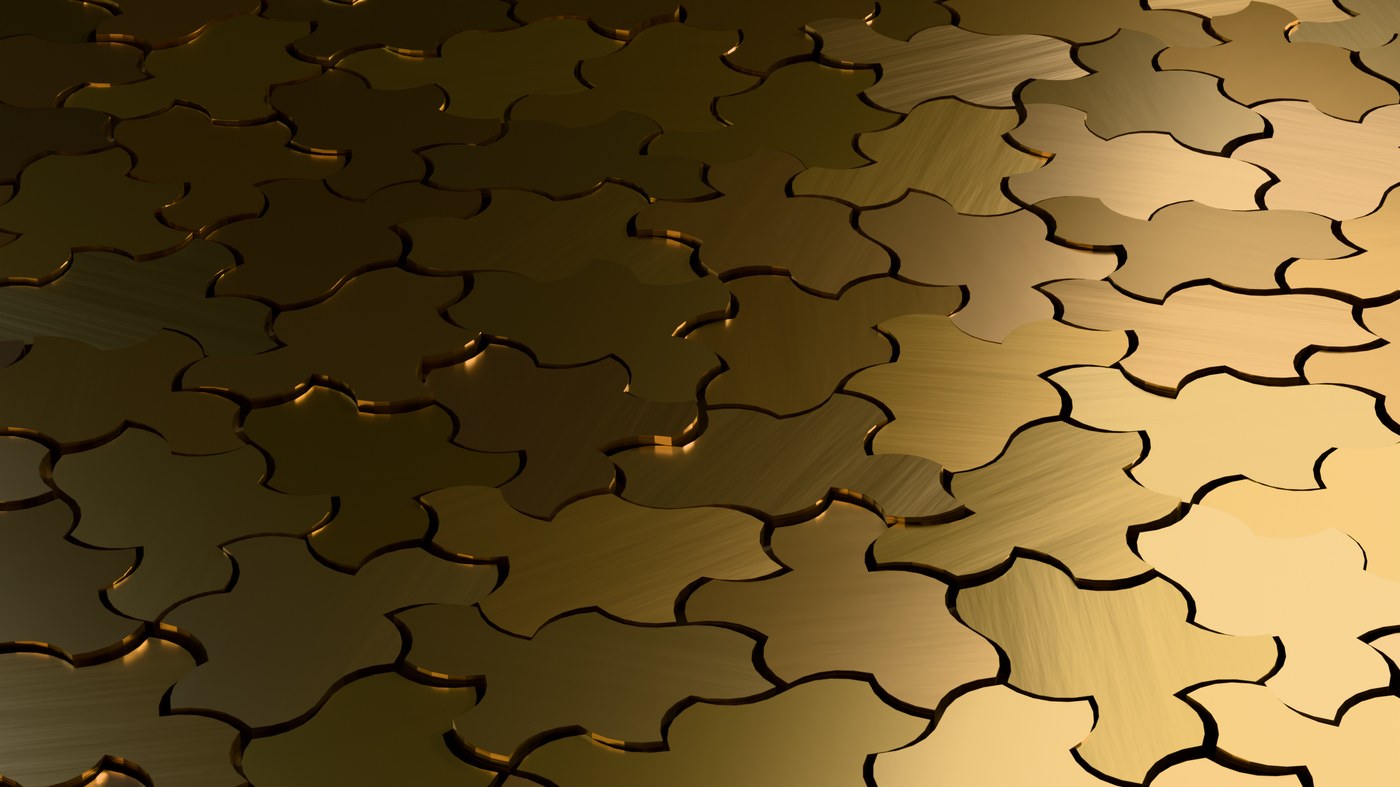
The chirality result can simplify part inventory: Spectre tilings do not require a second mirrored outline.[2] Tool count still depends on edge variants, draft, finish, and process. Community fabrication files, OpenSCAD models, STLs with orientation grids, laser-cut outlines, are indexed in the bibliography and Resources and tools. Digital monotile geometry has been used to manufacture PLA Hat-wall honeycombs[42] and PolyJet multiphase fracture panels.[46][49] Their measured performance came from the complete specimen, topology, materials, interfaces, dimensions, process, and loading, not from the export format. Monotile kirigami currently establishes deployable geometry theoretically and computationally; force, fatigue, thickness, and fabrication-tolerance tests remain open.[51]
Choosing and preparing an export
- SVG/DXF: planar outlines for laser, waterjet, router, plotter, or print. Confirm units, closed paths, winding, duplicate edges, and whether shared edges should be cut once.
- STL: watertight triangulated solids for printing. STL carries no reliable units, materials, hierarchy, or instance semantics, so include a manifest.
- GLB: compact meshes, materials, and scene transforms for review or instancing. Check axis convention, transform baking, normals, and material licensing.
- CSV/JSON: tile IDs, labels, parent clusters, positions, rotations, scale, and source version for CAM, robotics, or custom scripts. Publish a schema and coordinate convention.
Tolerance, kerf, grout, and chirality
Kerf is material removed by a cutting beam or tool. Offset toolpaths by the measured kerf, not the nominal machine setting, and cut a multi-tile coupon before a full sheet. For molded or printed parts, include shrinkage, clearance, corner radii, minimum wall thickness, and surface finish. For architectural tile, design the grout gap into the placement geometry; independently offsetting every complex outline can change which corners meet.
Preserve handedness through export and nesting. Straight Tile(1,1) and edge-modified Spectres have different reflection rules,[2] while face decoration or draft angle may make even a geometrically flippable part one-sided. Add an orientation mark and reject accidental mirror transforms in validation.
Validation workflow
- Hash or version the source outline and record units, scale, patch seed/root, and generator revision.
- Check closed polygons, self-intersection, overlap, gaps, duplicate paths, and transform handedness.
- Simulate nesting and tool reach; manufacture a coupon containing representative joints and corners.
- Measure actual dimensions, fit, warpage, and surface quality; update compensation from measurements.
- Dry-assemble a numbered cluster, then archive the final files, manifest, machine settings, and inspection results.
Evidence and candidate directions
- Measured in specific specimens: printed Hat honeycombs and multiphase composite panels, including an interdigitated derivative interface.[42][46][49]
- Constructed mathematically or computationally: topologically interlocking Spectre-derived blocks[50] and deployable monotile kirigami.[51] These papers establish geometric or kinematic possibility, not structural load capacity.
- Paper prototyping: fold-and-cut templates produce Hat, Turtle, and straight Tile(1,1) outlines after flat folding and one cut.[67]
- Candidate experiment: compare aperiodic and periodic infill at matched mass, process parameters, and boundary conditions; do not assume resonance or strength gains in advance.
- Support-free printing studies, topology optimization, and surface finishing
- Architectural panels, molds, product surfaces, screens, and repeat-free decoration
- Physical prototyping and load testing of mathematically constructed three-dimensional topological-interlocking blocks[50]
Origami-adjacent folding studies and flat-foldable synthesis environments show how computational tools explore fold-pattern spaces[26]; monotile kirigami extends this to deployable aperiodic sheets.[51] Mechanical performance belongs to the complete specimen, material, strut thickness, joints, defects, boundaries, and loading, not to the outline alone. “Monotile-inspired” lattices should be labeled as such when they modify the canonical geometry.
See also
Design, art, and architecture, Materials science and fluids
Categories: Applications