
Computer graphics
Using aperiodic monotile patches for scenes, textures, meshes, and sampling studies.
The problem with repeats
Every graphics artist knows the failure mode: a tiled texture or instanced grid looks fine up close, then the camera pulls back and the repetition snaps into view, visible seams, moiré shimmer, wallpaper patterns marching across the frame. The classic fixes all trade something away. Larger textures cost memory; randomized scatter loses structure and is hard to make deterministic; blend-based tiling blurs detail.
An aperiodic monotile patch attacks the root cause. The geometry itself is mathematically incapable of translational repetition,[2] yet it is a single instanced shape, one mesh, one material slot, one draw-call strategy, and every placement is deterministic and seed-stable. You get grid-like production economics with no translational repetition in the generated layout. Memory and draw-call costs still depend on implementation.
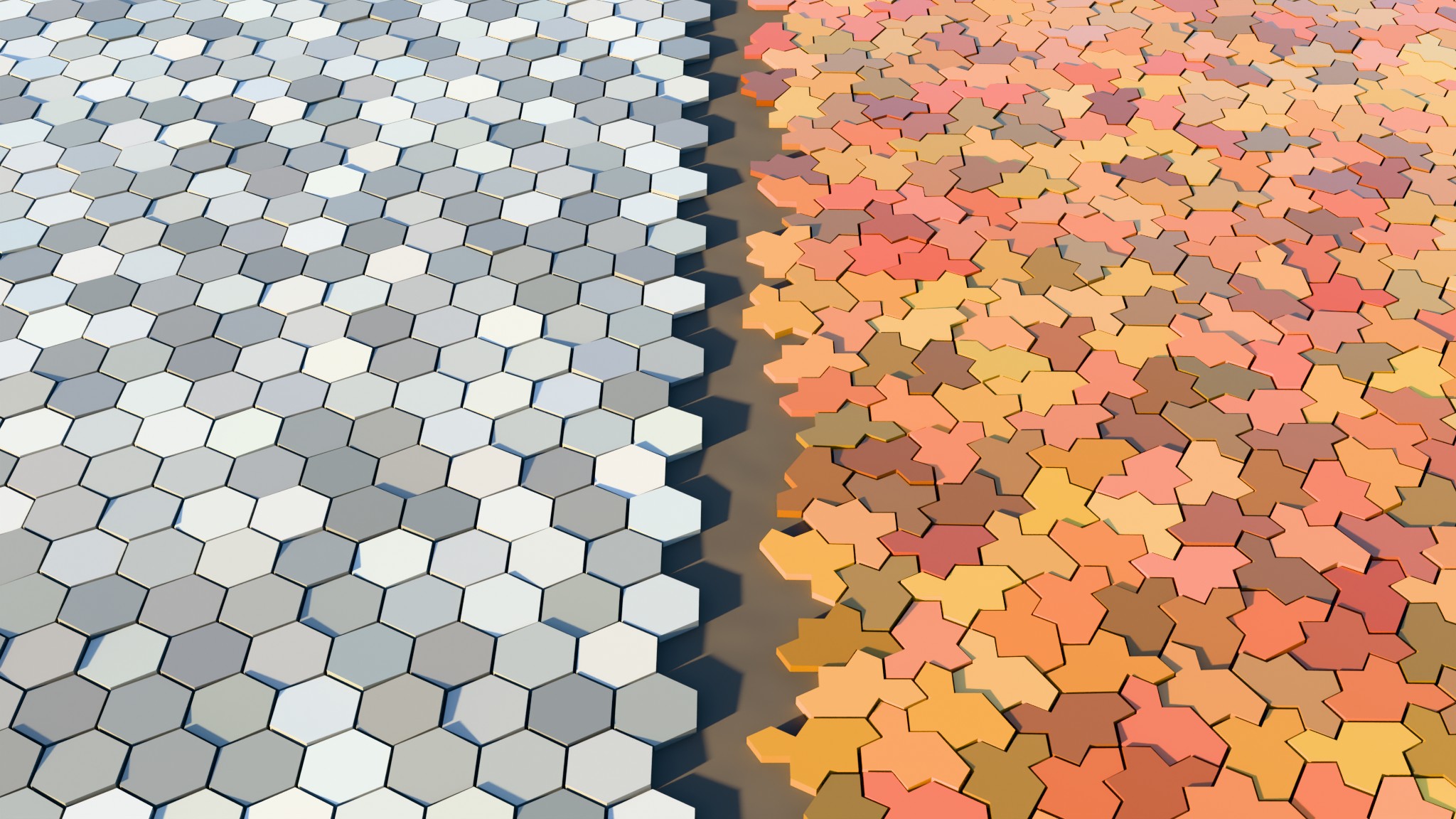
Same material, different geometry
The split render above makes the argument visually: identical glazed-ceramic material, identical sun, one seam. The hexagonal floor on the left is calm but visibly repetitive, the eye finds rows quickly, and at some render scales those rows can become aliasing bands. The Spectre floor on the right has the same nominal tile density and one base outline, but lacks a translational repeat. Finite motifs still recur, and the render remains subject to filtering and edge aliasing. For the sampling story, see Aliasing.
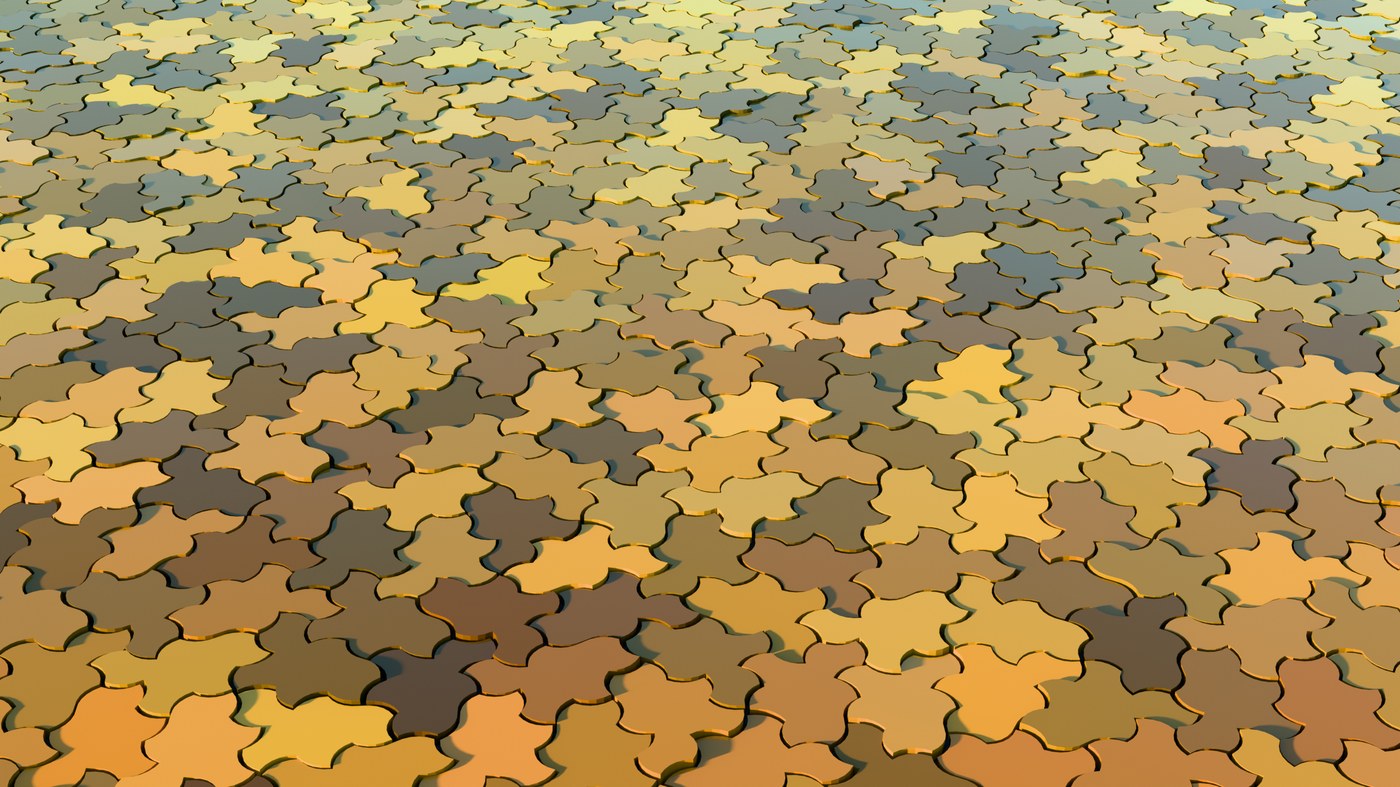
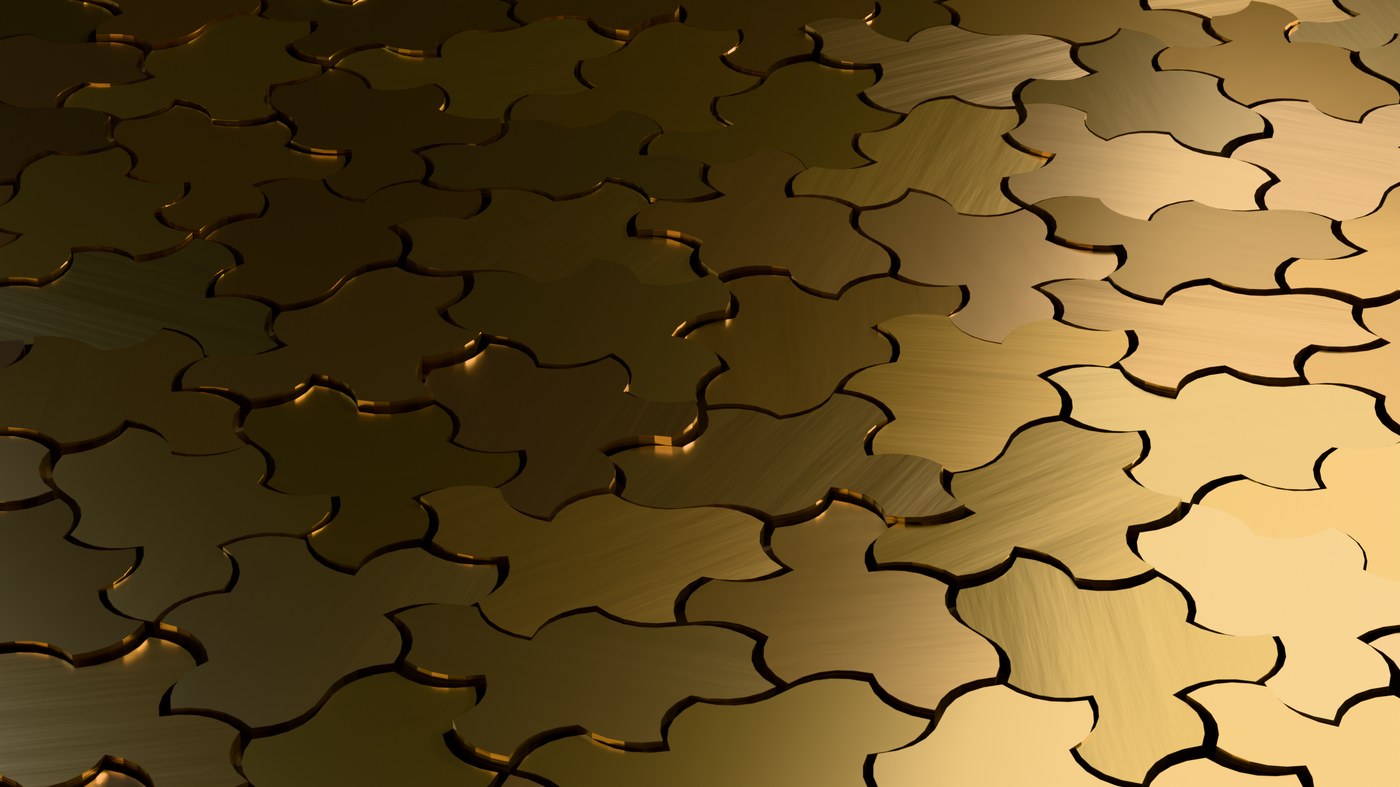
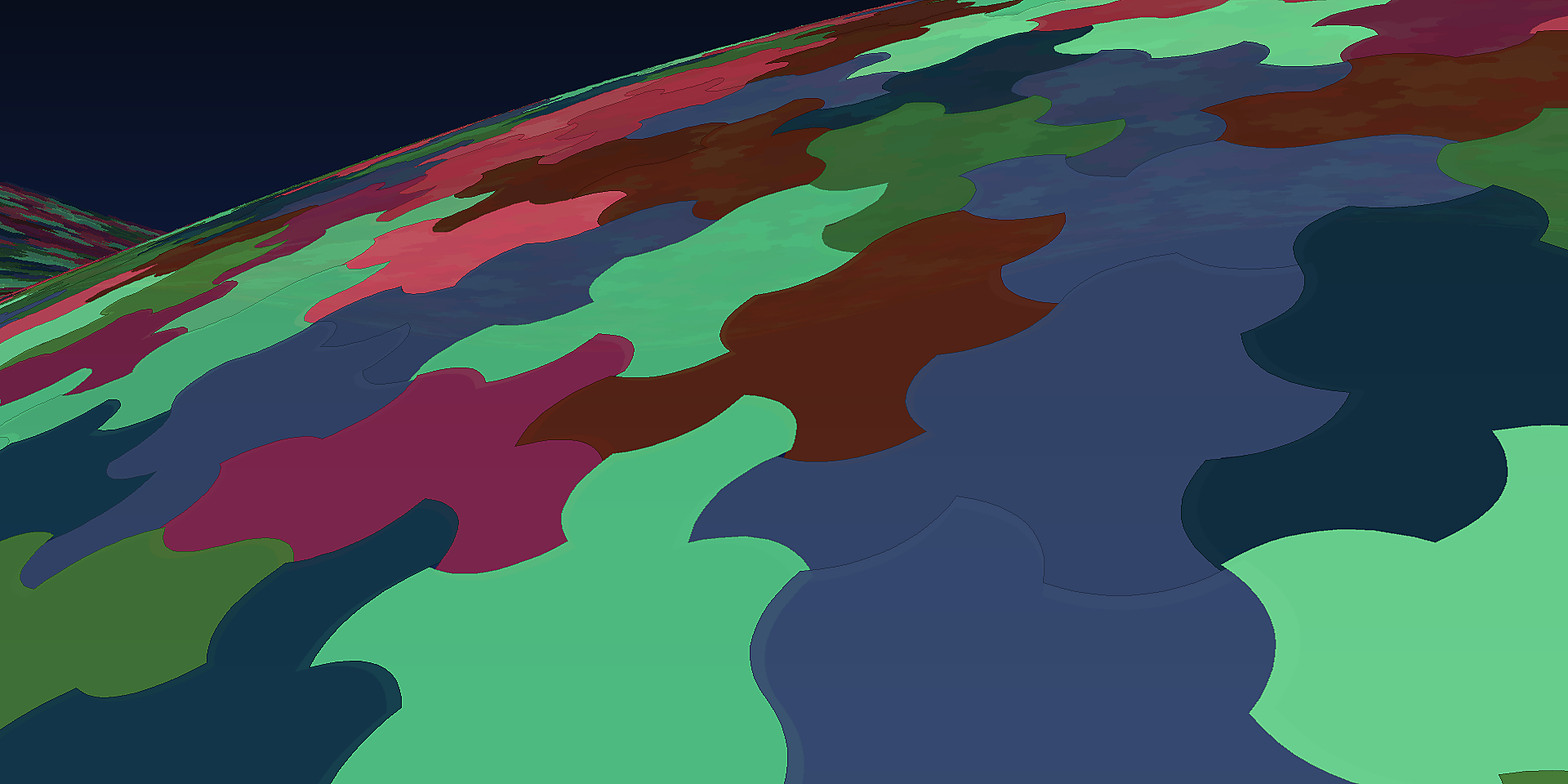
Production pipeline
Start with one canonical polygon and a transform table. Generate beyond the camera footprint, clip only if the asset needs a hard boundary, triangulate the base tile once, and apply each row’s translation and rotation as an instance transform. Keep geometry coordinates, tile ID, hierarchy label, and material class in separate attributes so layout changes do not invalidate shading.
- Generate and validate a patch at world scale; retain provenance and units.
- Import CSV/JSON transforms for instancing, or GLB for a portable scene; use SVG for masks and decals.
- Assign colors or texture offsets from stable IDs or hierarchy labels rather than frame-dependent randomness.
- Bake normals, displacement, or albedo only after deciding the camera-distance and texel-density targets.
- Test animated cameras with temporal anti-aliasing, mipmapping, and anisotropic filtering enabled.
Interfaces with periodic regions can be designed explicitly when a scene needs both.[18]
Instancing, sampling, and level of detail
For large patches, avoid one object and one draw call per tile. Store the mesh once, batch transforms in an instance buffer, frustum-cull by hierarchy cluster, and merge only distant clusters. A hierarchy gives natural level-of-detail units, but coarse meshes must preserve silhouettes and material statistics or they will pop. Measure frame time, GPU memory, draw calls, overdraw, and visible seam count against a periodic grid and a randomized scatter with the same tile density. Finished scene loops from the same pipeline are collected on the art page.
Aperiodic placement changes the spectrum of the layout; it does not band-limit the texture painted on each tile. Use mipmaps for color, filtered displacement or normal maps, adequate UV gutters, and supersampled vector rasterization. Tile centroids can also serve as deterministic sample points, but reconstruction quality must be measured against grids, jittered grids, and blue noise rather than inferred from appearance.[37]
Limitations
Aperiodicity does not automatically remove texture seams, UV discontinuities, jagged silhouettes, temporal shimmer, clipping artifacts, or poor level-of-detail transitions. A finite patch can still show large-scale bias, and a repeated finite patch is periodic regardless of how it was generated. The safest claim is narrower: canonical monotile transforms provide a deterministic layout without translational repetition, leaving ordinary graphics engineering responsible for filtering and performance.
See also
Moiré, Aliasing, Design, art, and architecture
Categories: Applications