
Four-dimensional lift
Nan Ma’s coherent ℝ⁴ edge lift, and how it differs from CAP/CASPr cut-and-project theory.
A two-shadow analogy
Imagine drawing one path with two transparent inks, then making a flat image by giving each ink a different scale. Changing those two scales changes the shadow, while the colored source path stays the same. Nan Ma’s lift applies this idea to the two direction classes in the Hat family: store them in two separate coordinate planes, producing four coordinates in total, then project back to two or three dimensions.[54]
In that sense the whole Hat or Spectre tiling can be treated as a single static object in four-dimensional space. Arnaud Chéritat credits the initial idea to Nan Ma: not merely lifting one Tile(a,b) outline, but assigning coherent ℝ⁴ coordinates to every vertex in an entire simply connected tiling.[54] Ma’s earliest securely dated public artifact is the aperiodic-monotile-4d repository created 9 June 2023.
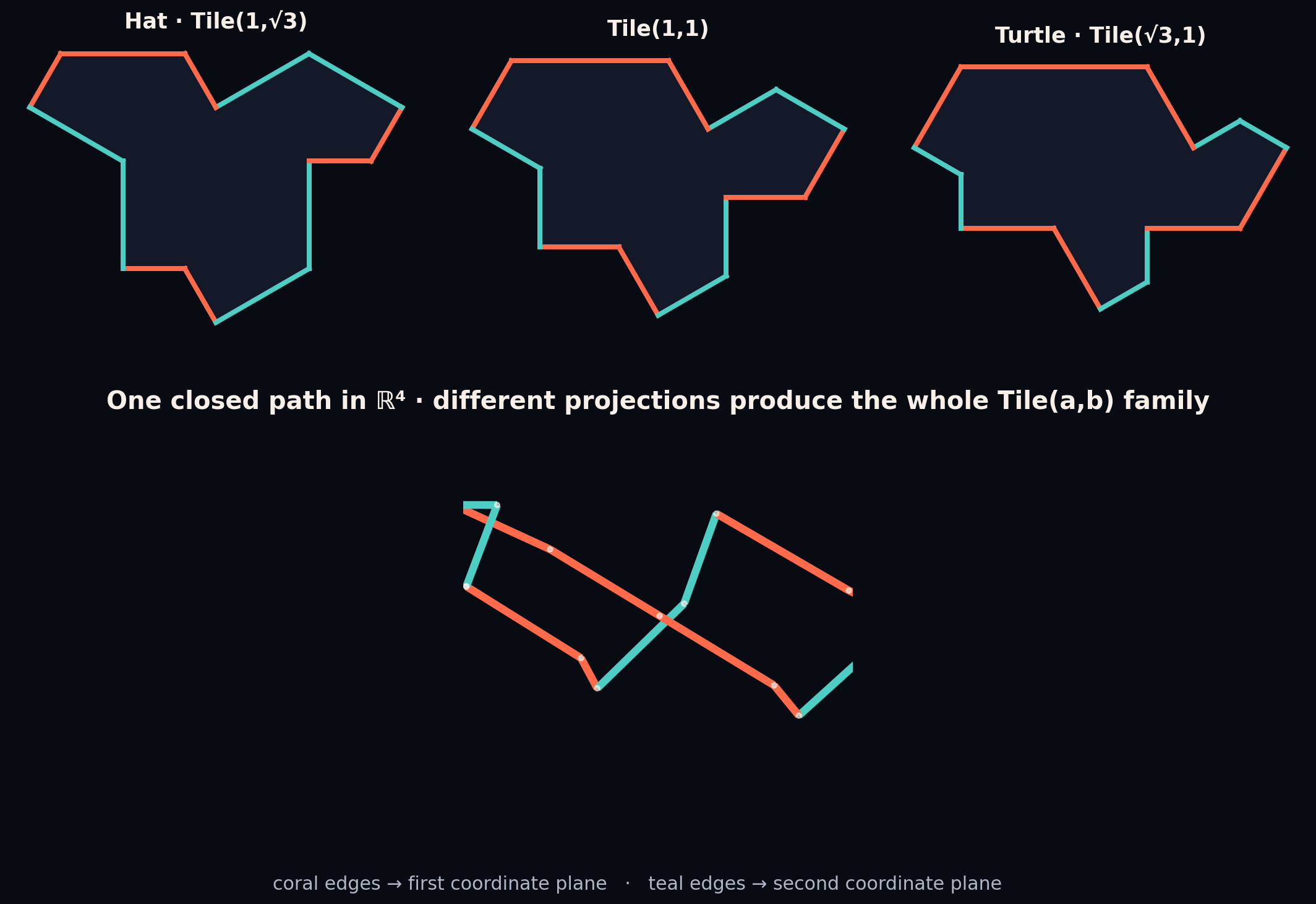
How the lift works
Write four-space as ℝ⁴ = ℝ²red × ℝ²green. Tile(a,b) has two direction classes: edges at multiples of 60° and edges at odd multiples of 30°. A directed edge (x,y) in the first class lifts to (x,y,0,0); one in the second lifts to (0,0,x,y). Opposite edges cancel by class, so the fourteen lifted vectors close into one polygonal path in ℝ⁴.
The ordinary two-dimensional tile is recovered by La,b(u,v) = a u + b v. Changing (a,b) changes the projection, not the lifted object: Hat, Tile(1,1), Turtle, Chevron, and Comet are views of the same four-dimensional edge path. Adjacent tiles give their shared edge the same lifted vector; integrating these vectors gives path-independent vertex coordinates across any simply connected patch.[54]
For homochiral Tile(1,1)/Spectre tilings, tiles rotated by an odd multiple of 30° swap the two edge classes. Animations vary an ℝ⁴→ℝ³ projection while the lifted surface stays still. This is why a complicated coordinated deformation can be understood as moving a camera around one higher-dimensional object.
Scope and limits
Ma’s construction is best understood as a discrete height function or stepped surface. The edge lift is canonical, but filling each lifted tile interior with a surface is not unique; rendered solids include a visualization choice. The lift does not by itself prove that Hat or Spectre control points form a regular model set.
That stronger result comes from distinct work. Baake, Gähler, and Sadun construct the self-similar CAP representative of the Hat family and a 4:2 cut-and-project scheme with two-dimensional internal space.[31] Baake, Gähler, Mazáč, and Sadun do the analogous job for Spectre via CASPr and five Rauzy-fractal windows, proving pure-point spectrum and diffraction.[32] These frameworks use algebraic return modules, Galois conjugation, and acceptance windows, not Ma’s edge coloring.
A third meaning of “lift” appears in architecture: van Dongen constructs three-dimensional polyhedral Hat and Turtle wall modules from lifted double-kites.[69] That work concerns a buildable surface vocabulary, not ℝ⁴ coordinates or a model set. For formal definitions and a checklist, see Cut-and-project schemes and model sets.
Six dimensions and diffraction
Socolar’s independent Golden Key construction embeds a related Hat metatiling in a six-dimensional hypercubic lattice and projects selected points to the plane, establishing golden-mean quasiperiodicity and a phason degree of freedom.[6] Exact diffraction calculations later use CAP and CASPr reprojections plus renormalization cocycles to compute Fourier-Bohr amplitudes through fractal windows.[35][36]
These are complementary views: Ma’s lift explains the moving Tile(a,b) family geometrically; CAP/CASPr explain long-range order dynamically; the six-dimensional Golden Key construction exposes a larger quasiperiodic embedding.
Explore it
- Chéritat and Ma’s full exposition
- Interactive 4D projection applet (CC BY-SA)
- Nan Ma’s Wolfram Language repository (no license; link only)
A practical visualization starts with a small validated Tile(a,b) patch, assigns the two edge classes contrasting colors, integrates lifted vertex coordinates, and animates a linear projection to 3D. Show the original 2D patch beside the projection and preserve tile IDs so viewers can track one face. Self-intersection in the 3D view is a projection effect, not necessarily a defect in the lifted surface.
See also
Aperiodic monotile, Spectre tile, Substitution tiling, Cut-and-project schemes and model sets
Categories: Mathematics · Visualizations