
Aperiodic monotile
A single shape that tiles the plane without any repeating translational pattern.
Definition
Three terms are easy to confuse. A monotile is one shape used to cover the plane. A monohedral non-periodic tiling is one particular non-repeating arrangement of one shape, even if that shape also permits a repeating arrangement. An aperiodic monotile is stronger: congruent copies cover the plane, but no valid tiling has translational periodicity.[1][3]
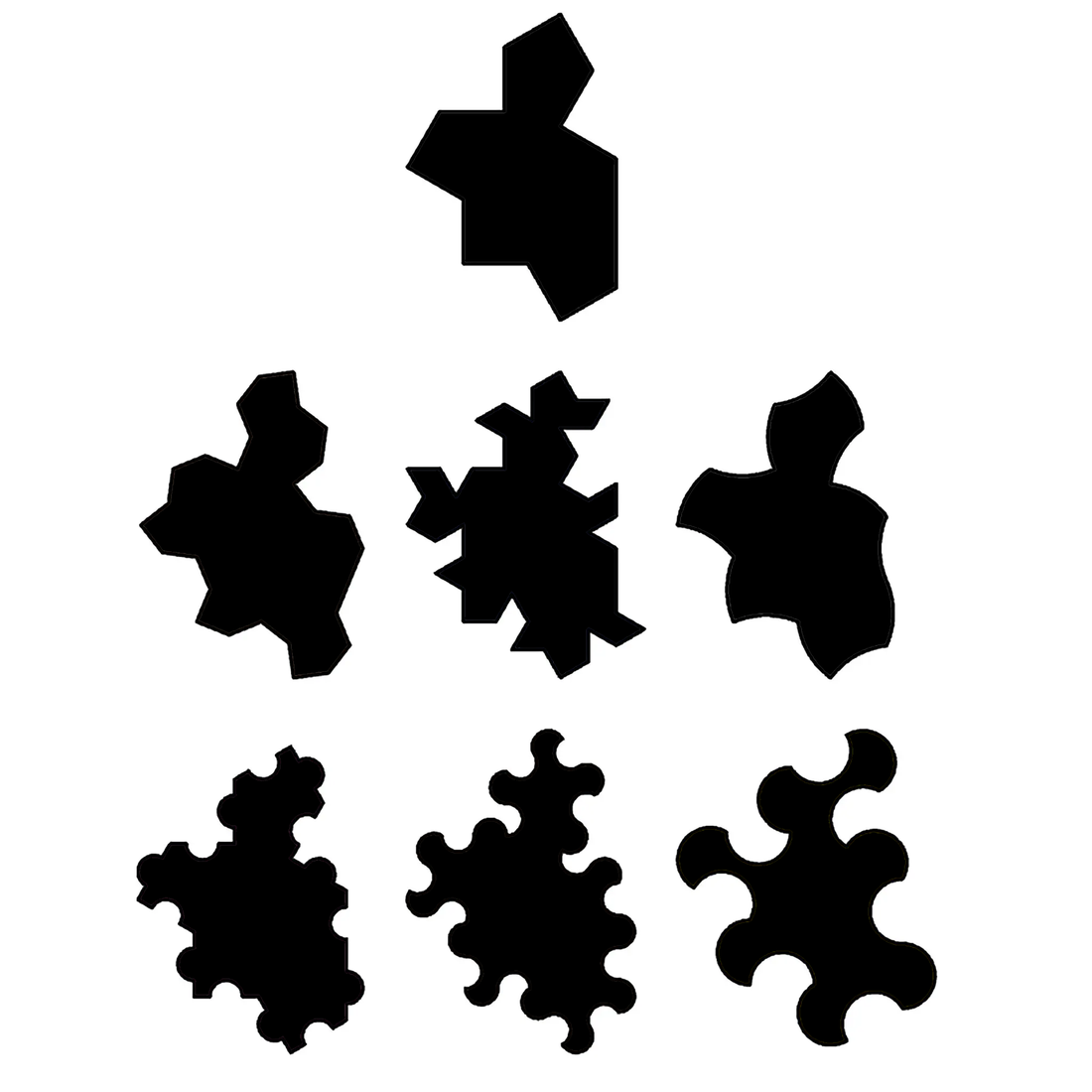
The long-standing einstein problem (German ein Stein, "one stone") asked whether such a shape exists. David Smith, Joseph Samuel Myers, Craig S. Kaplan, and Chaim Goodman-Strauss answered it in March 2023 with the Hat tile,[1] followed two months later by the strictly chiral Spectre tile.[2] Independent proofs and alternative constructions followed within months,[4][5] a measure of how much attention the discovery drew.
Sixty years of near misses
The road to the monotile runs through most of modern tiling theory.[3] Wang tiles (1960s) first linked tiling to logic: Berger proved the tiling problem undecidable by building aperiodic sets of over 20,000 square tiles. Raphael Robinson cut that to six; Penrose reached two with the kite and dart in 1974. For nearly fifty years the count sat at two, with mathematicians unsure whether a single-shape solution existed at all. Recent work continues to map where the boundary of decidability lies, translational tiling is undecidable for three connected polyhypercubes in four dimensions,[24] translational monotiles are undecidable in higher dimensions,[56] and the structured-versus-wild dichotomy for translational tilings remains an active frontier.[23]
Adjacent discoveries continue: an aperiodic set of three convex polygons was found in 2024,[15] and SAT solvers are now used to search polyform space for shapes with prescribed tiling behavior.[17]
Ordered without repeating
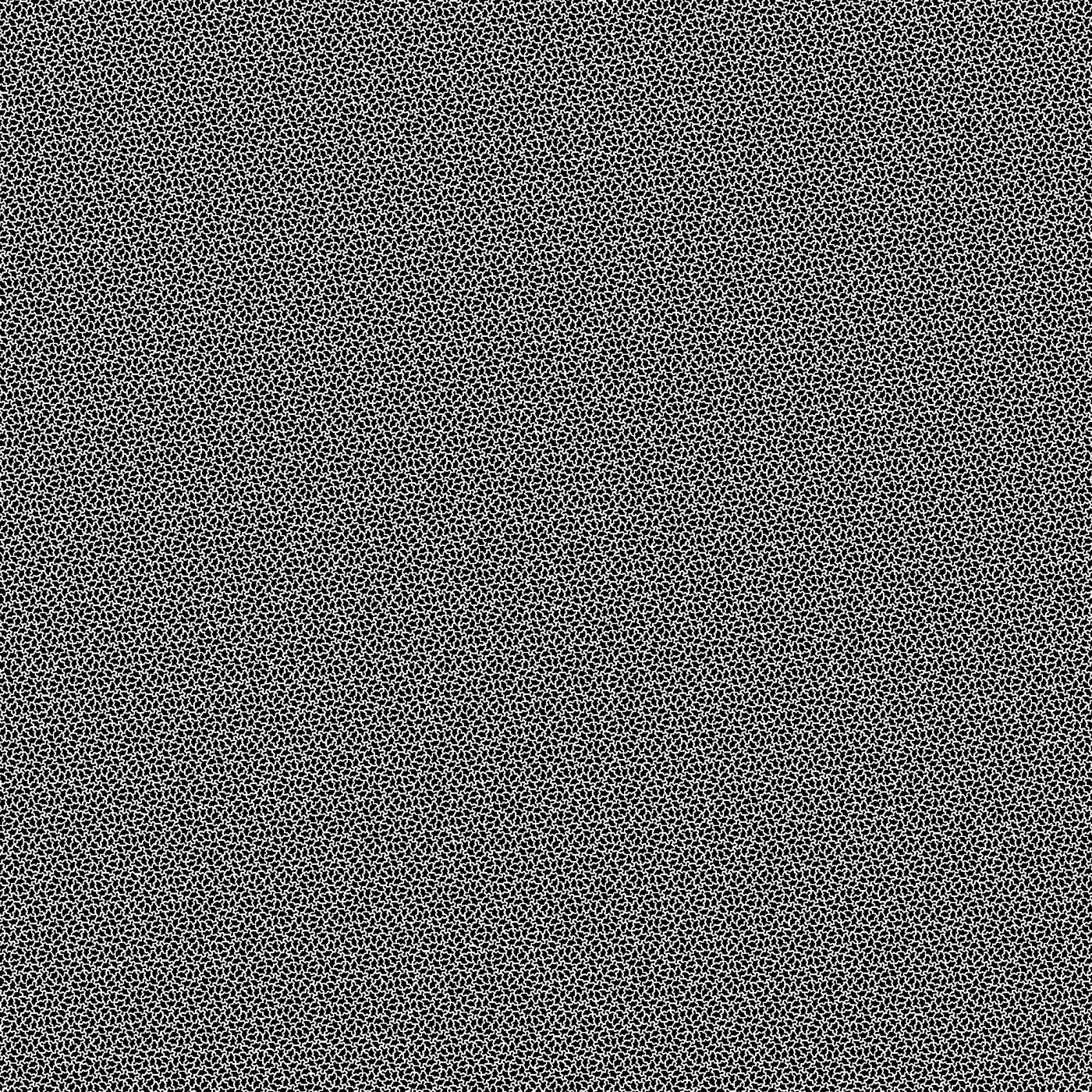
Aperiodic tilings are not random. They are among the most structured objects in geometry: every tile sits in a deterministic hierarchy produced by substitution rules,[2][10] tile counts across generations follow Fibonacci-like recurrences,[12] and the diffraction structure of Hat tilings is quasicrystalline, sharp peaks, like a crystal, but with symmetries no crystal can have.[6]
For practical work, a chosen substitution construction can regenerate a patch, scale it, and export stable tile IDs. That gives a reproducible geometric dataset rather than random noise. Aperiodicity does not mean that every small neighborhood is unique: finite motifs recur. Within one fixed finite patch, however, a sufficiently large local neighborhood can identify position, which is useful for experiments in localization and indexing. Those are engineering opportunities, not consequences proved for every sensor or every generated patch.
Weak vs strict chirality
The Hat tile is asymmetric: every Hat tiling contains mostly one handedness and a smaller, required population of reflected copies. Standard tiling terminology normally allows every rigid motion, including reflection, when it calls two copies congruent; a fabrication process with decorated faces may nevertheless have to treat the two handed parts as distinct products.[1][3]
The Spectre tile closed the question. Tile(1,1) is weakly chiral, banning reflections by rule leaves only non-periodic tilings, and its curved-edge Spectre variants are strictly chiral: the geometry itself makes reflected copies unusable, so only single-handed non-periodic tilings exist.[2] That distinction matters physically. A glazed ceramic tile or other one-sided part may not be usable face-down. A homochiral layout can reduce part variants, but it does not by itself determine tooling cost or prevent installation errors; edge keys, markings, tolerances, and the selected patch still matter.
Miki Imura monotile
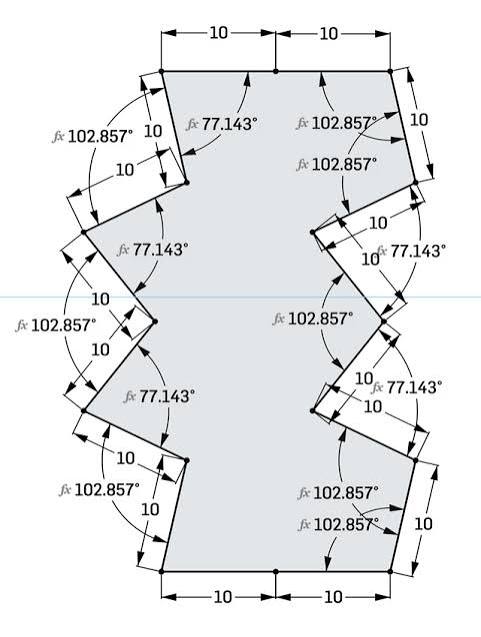
Not every monotile that makes non-periodic patterns is an aperiodic monotile. In 2025, Miki Imura published a family of equilateral “Modulo Krinkle” tiles that tile the plane with a single shape and can form striking non-periodic arrangements, often spiral or ring-like, using only elementary modular-arithmetic constructions.[71]
The catch, which Imura states explicitly: the same prototile also admits an ordinary periodic tiling. So it is a monohedral tile with rich non-periodic modes, not an einstein. It belongs on this page because the popular conversation lumps “one shape that tiles without repeating” together; the mathematical distinction is whether every tiling must be non-periodic, or only some of them.
Evidence, use, and limits
The established result is mathematical: the Hat and Spectre papers prove that valid infinite tilings exist and that periodic ones are excluded under their stated congruence and reflection rules.[1][2] The proof strategy is not “the patch looks irregular.” It converts tiles into a finite collection of labeled clusters or metatiles, proves that every tiling must decompose into those larger units, and repeats that decomposition at arbitrarily large scales. A finite translation period cannot survive that forced hierarchy. Independent proofs and direct constructions check the conclusion by different routes.[4][5]
Finite exports are samples of an infinite system, so clipping a patch can hide hierarchy and create boundary fragments. Claims about strength, optics, localization, or visual quality require separate controls; aperiodicity alone proves none of them. The practical value is a precisely specified, non-periodic geometry on which those questions can be tested.
See also
Spectre tile, Hat tile, Substitution tiling
Categories: Concepts · Mathematics