
Moiré
Layered aperiodic arrays produce moiré landscapes, phason rivers, and a navigable perceived 3D space.
What moiré is
In optics and imaging, a moiré pattern is a large-scale interference figure that appears when two similar periodic or quasi-periodic structures are overlaid — fabrics, fences, screens, or printed grids. The eye (or a camera) does not see either layer’s fine detail; it sees the beat between them: bright and dark regions where local alignment reinforces or cancels.
Aperiodic monotile arrays make that classic idea richer. Because each layer is ordered but non-repeating, the beat field does not collapse into ordinary wallpaper. Instead it yields cells, channels, and gradients that stay deterministic and seed-stable while still feeling organic.[6] For the related sampling problem — false patterns from under-resolving a single lattice — see Aliasing.
Layered arrays and beat patterns
Take one aperiodic monotile array and layer a second copy on top — same seed, same tile scale, but offset by a small transform: a translation (tx, ty) and/or a rotation θ away from perfect alignment. Where the two structured layers agree locally, contrast cancels; where they disagree, macroscopic bright and dark regions appear. The result is a new visual field that was not present in either layer alone.
Because both layers are aperiodic, the beat pattern does not settle into a simple repeating wallpaper. Instead it produces large-scale structures — cells, channels, and gradients — whose topology changes smoothly as you adjust the overlay parameters. The same deterministic patch can therefore encode a family of related moiré images, all reproducible from the same tile data.
Near-alignment: rosettes and perceived depth
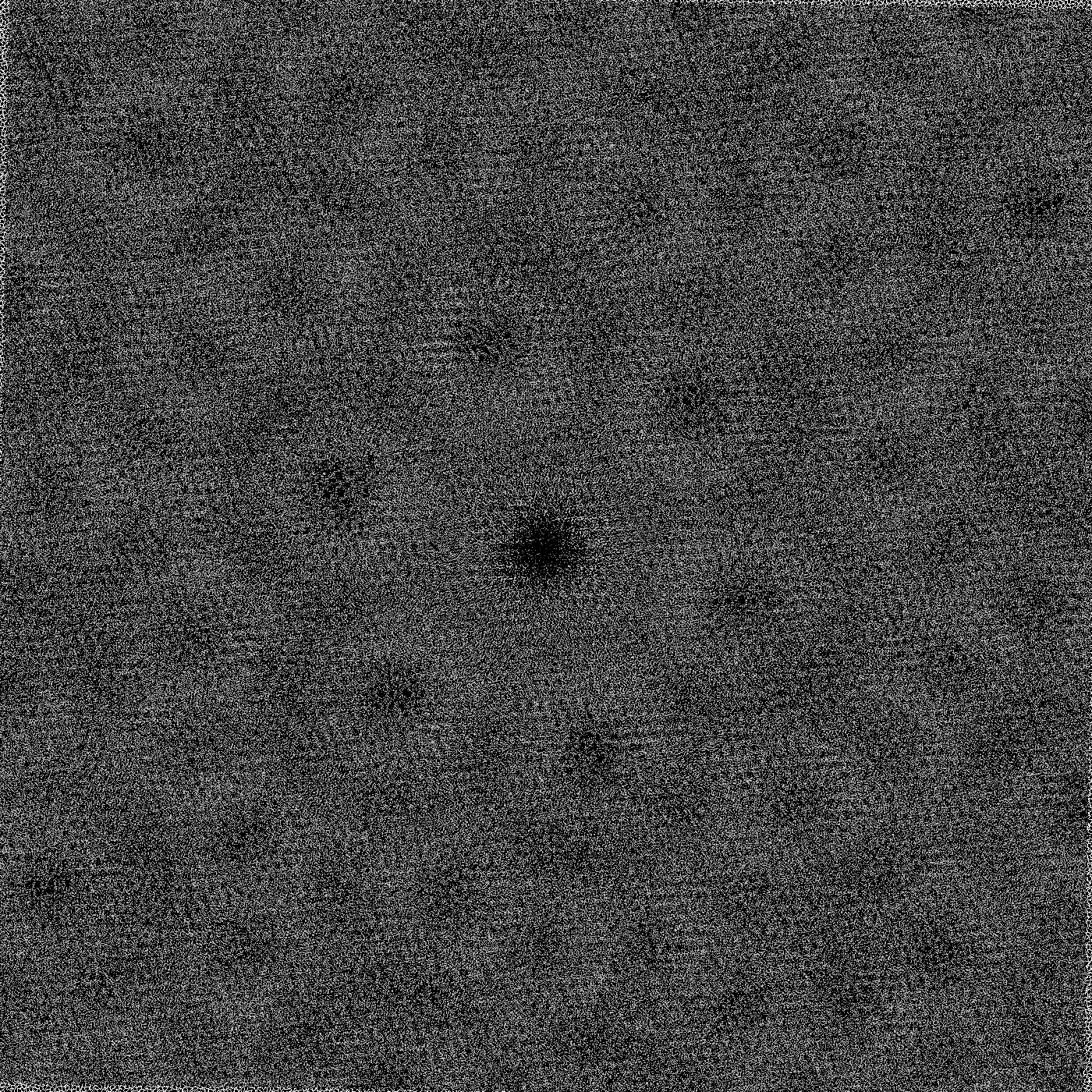
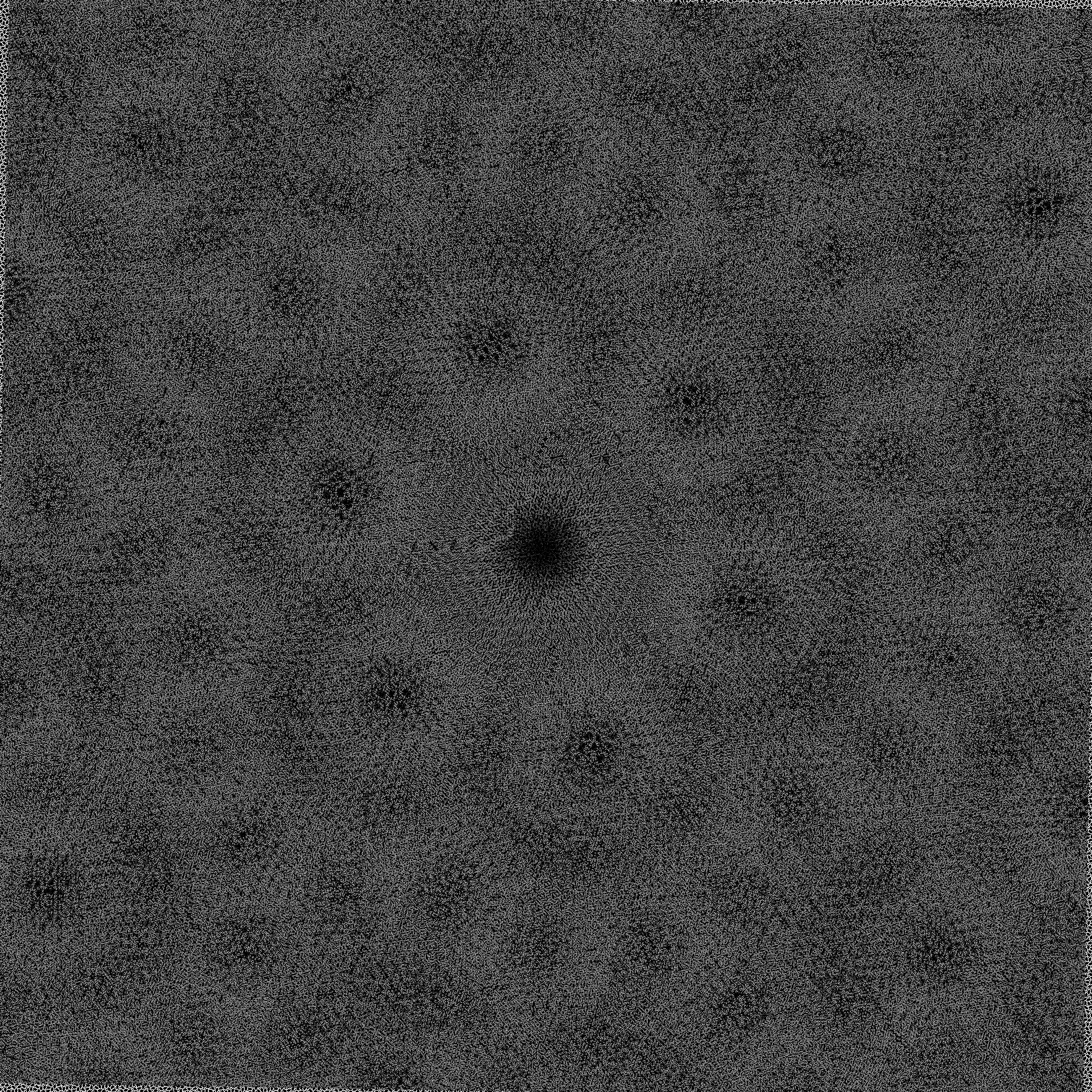
At very small rotations from pure alignment — on the order of one degree — the interference often organizes into radial rosette or cell-like structures: a bright or dark focal center surrounded by lobes that read almost like flowers or lenses. These are not random halos; they are the macroscopic signature of microscopic tile disagreement accumulating across the patch (see the figure at left).
Observers often describe this field as a navigable 3D space: nudging tx and ty pans across the moiré terrain, while small changes in rotation θ act like a zoom or dolly — the rosette cells expand, contract, and hand off to neighbors without ever repeating on a simple grid. The perceived depth is an optical effect, not true geometry, but it is stable and controllable — which makes it interesting for interfaces, data visualization, and spatial encoding.
Phason rivers
At larger rotation offsets the beat field changes character. For example, at 60° between layers, interference can organize into winding, channel-like structures — phason rivers — that flow in broad strokes across the patch. In quasicrystal physics, a phason is a type of structural rearrangement; here the term is used informally for these moiré channels: coherent pathways where the two arrays stay in partial registry over long distances before shearing apart.
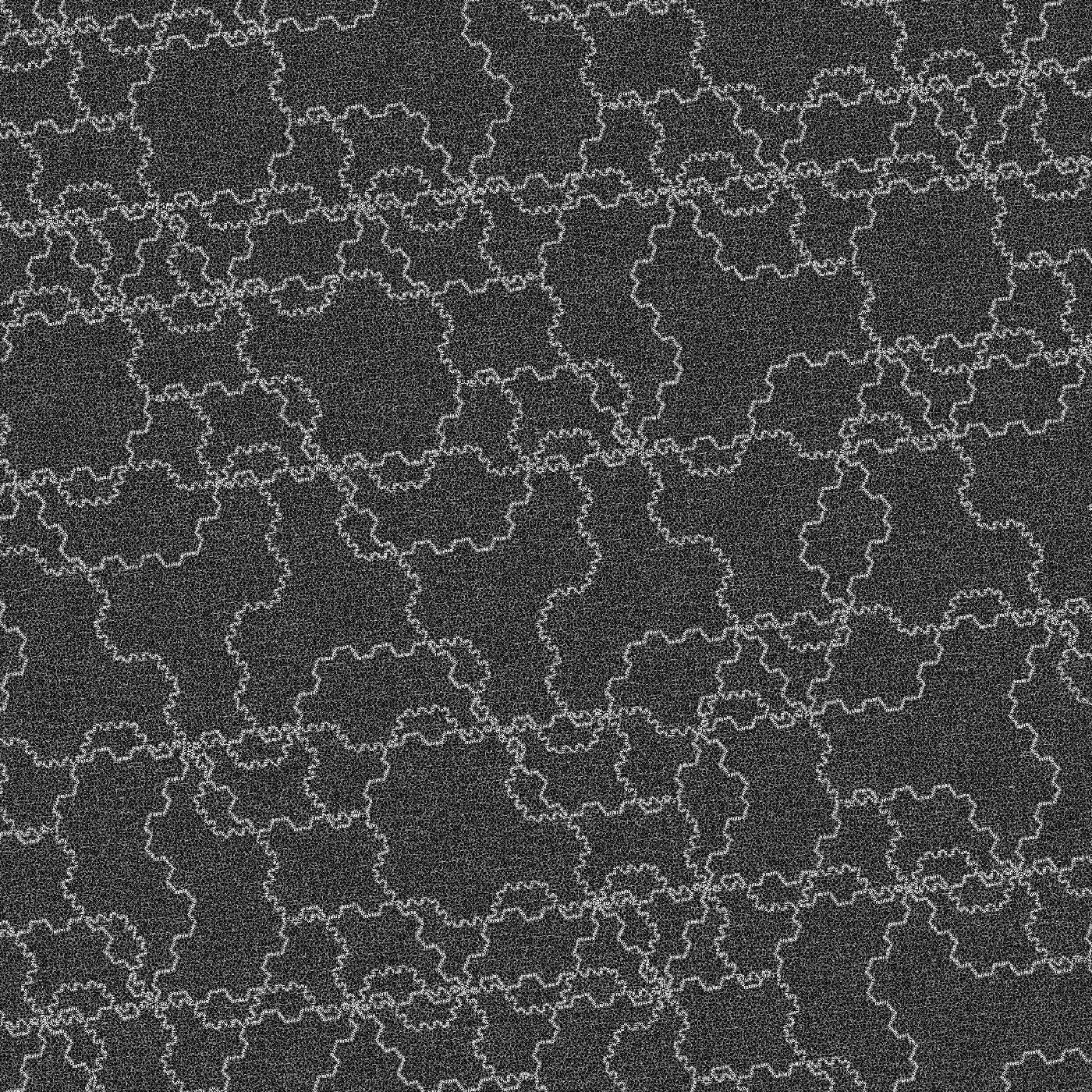
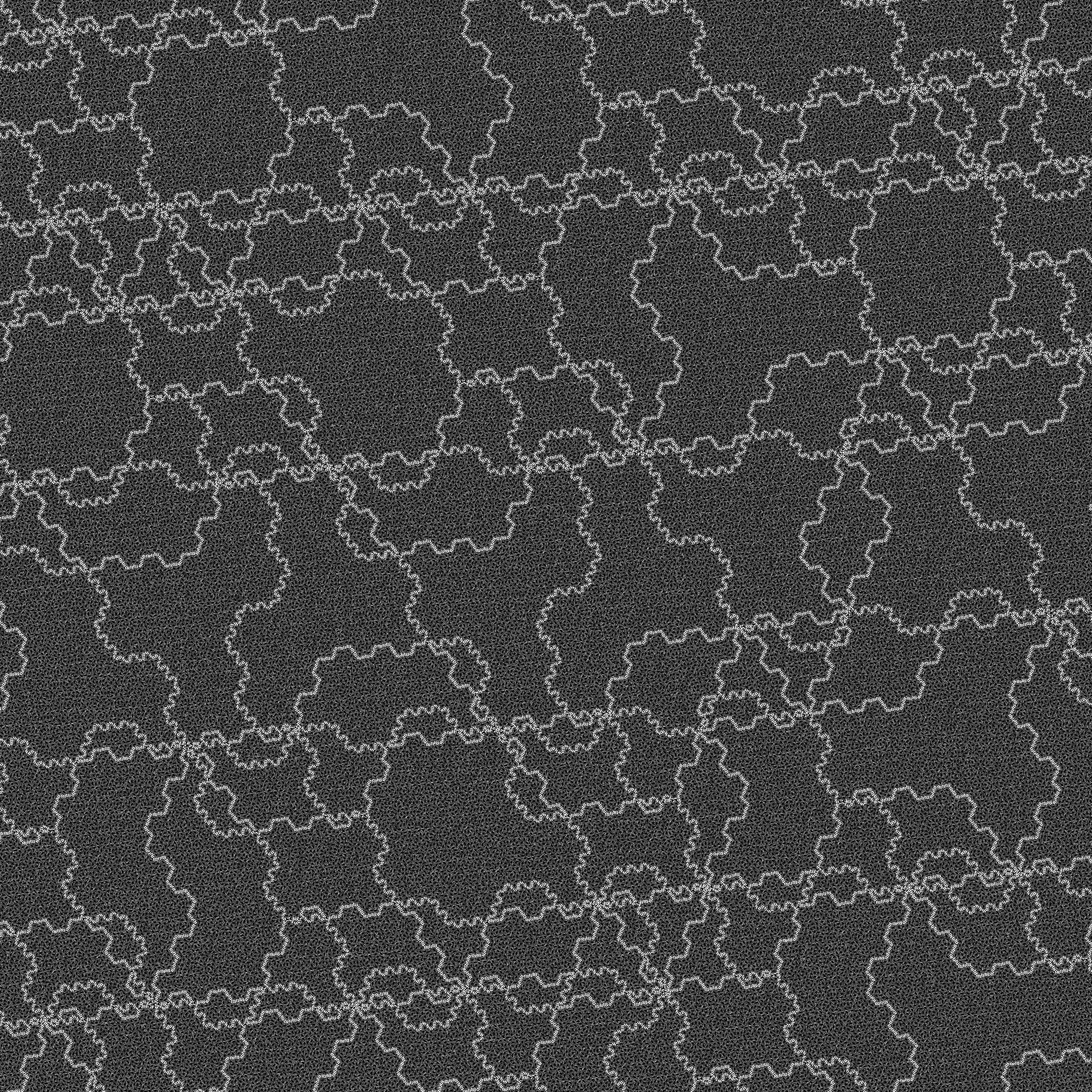
Unlike the near-aligned rosettes, phason rivers are not intuitive. Their paths, branch points, and sensitivity to tiny parameter changes are not yet well characterized for aperiodic monotile arrays. Which rotations produce stable rivers? Do rivers form a navigable network or fragment under translation? Can they encode data or serve as routing channels? These questions are open research frontiers — worthy of systematic study now that monotile patches can be generated and overlaid reproducibly.
Navigation as a control space
Treat the overlay parameters as a three-degree-of-freedom control space:
- tx, ty — translate the upper layer; the moiré field scrolls, revealing new river segments or rosette cells.
- Rotation θ — twist the upper layer; at small θ the effect reads as zoom or magnification through the cell structure; at larger θ the topology shifts toward river networks.
Because the underlying arrays are deterministic, every position in (tx, ty, θ) maps to a unique, reproducible moiré image. That makes the beat field a candidate for indexed visual storage, generative art, and experimental interfaces where a user explores a perceived 3D landscape by steering three continuous parameters.
Where it shows up
- Layered overlays for generative art and data visualization
- Experimental interfaces that treat (tx, ty, θ) as a navigable space
- Print and fabrication stacks where two structured layers meet
- Research into phason-like channels on aperiodic lattices
Related sampling and display artifacts are covered under Aliasing. See also Computer graphics and Signal processing and imaging.
See also
Aliasing, Computer graphics, Signal processing and imaging, Aperiodic monotile
Categories: Concepts · Computer graphics · Research frontiers